AERIS: Bringing Automation to the Study of Soft Materials
September 4, 2026 · Frank Gu
Share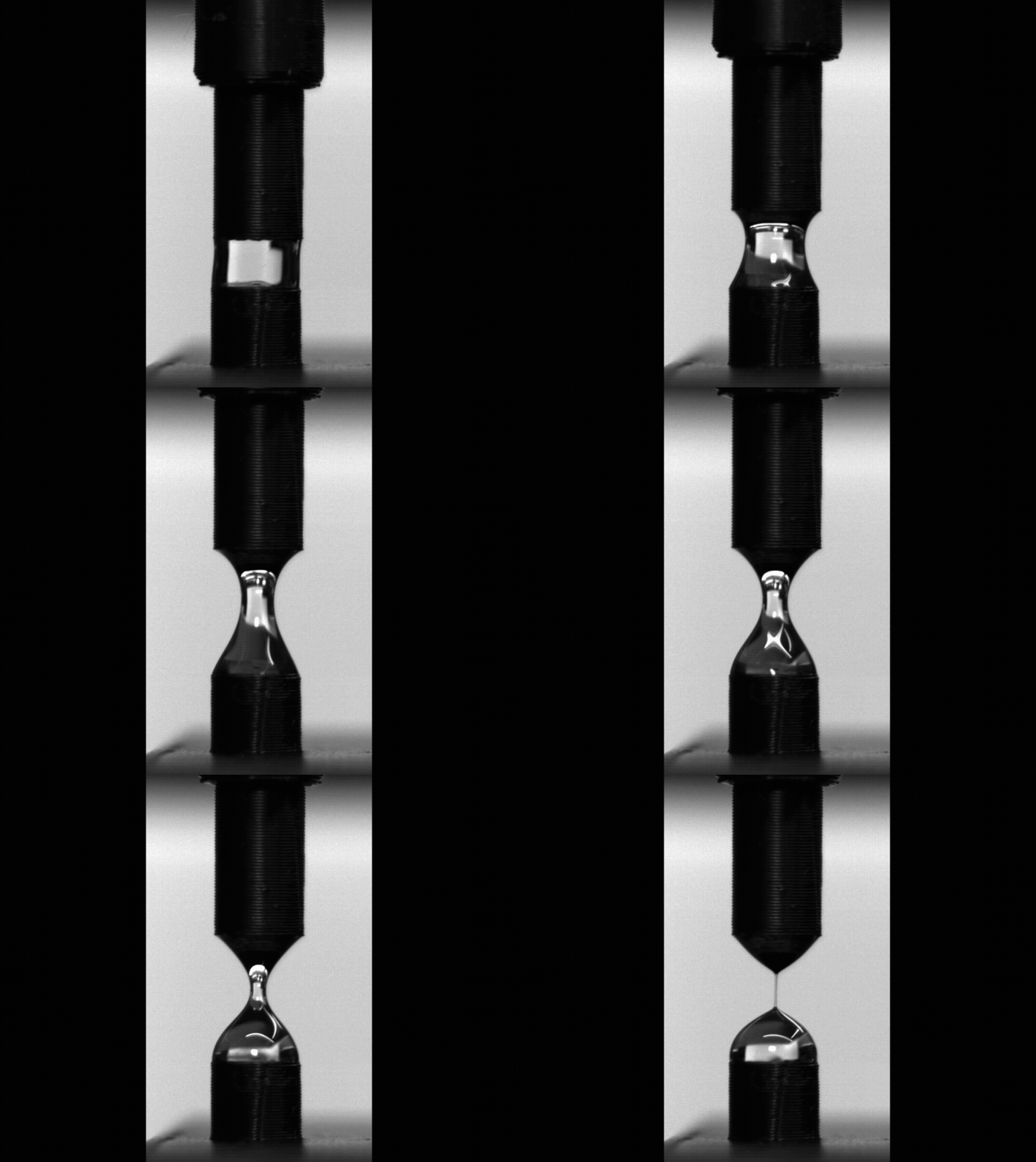
Automating the “thumb and forefinger test” – stretching a material between your fingers to observe how thick it is based on how it breaks – to study how formulation impacts material viscoelasticity.
Soft materials, which have a combination of both solid-like and liquid-like properties, can change structure as a result of stretching, compressing or shearing. Aloe vera jelly deforms to travel through the outlet of a bottle, holds its shape after dispensing, but spreads when applied to skin. Or a dermal filler thins when sheared through a syringe during injection, but should hold shape after application to provide a fuller appearance.
Understanding how the composition of a soft material impacts how it responds to deformation – its viscoelasticity – is essential to the discovery and development of formulations for applications ranging from biomedical materials to consumer products. However, characterizing these materials can require specialized equipment, careful sample preparation, and time-consuming experiments. When combined with large design spaces, formulation discovery can be a laborious and lengthy process. What if some of these measurements could be performed using an accessible, automated laboratory platform?
In our recent preprint (10.26434/chemrxiv.15007811/v1), we discuss the development of AERIS (Automated Extensional Rheology Imaging System), which explores this possibility.
Looking beyond conventional shear rheology
Many soft materials, including polymer solutions and hydrogels, exhibit complex viscoelastic properties – and this behaviour is directly tied to their internal structure – influenced by its composition. The standard method used to characterize material viscoelasticity is oscillatory shear rheology. While this method provides rich information about the material, experimentation takes at least 30 min to an hour per sample, and significant user intervention.
Another lens through which we can view a material’s viscoelasticity is after stretching, or extension, via extensional rheology. While less popular, extensional rheology can be more sensitive to the internal structure. One way to investigate this behavior is through capillary breakup extensional rheology (CaBER). In a typical CaBER experiment, a sample is placed between two parallel plates, which are pulled apart to form a liquid bridge. As the bridge stretches, its diameter decreases until the sample breaks or reaches another limiting state.
Building an automated rheology platform
AERIS was developed to accelerate formulation screening by combining an open-source liquid-handling robot, a high-speed camera, and custom-designed 3D-printed components to autonomously perform CaBER-type experiments. The system automates key steps in the experimental workflow: sample loading, entrapment, testing and data acquisition, and data analysis. By integrating these components, AERIS turns a series of manual experimental steps into a coordinated workflow. Its modular design also allows components to be adapted as experimental requirements change.
Importantly, with a throughput of up to 12 samples per hour (compared to 1-2 samples using a conventional shear rheometer), AERIS presents itself as a more rapid, and accessible screening platform to map important formulation-property relationships, and identify formulation candidates. Hits identified by AERIS can then by further investigated by conventional instruments for in-depth characterization of material properties.
Making laboratory automation more accessible
Our preprint demonstrates that, rather than relying exclusively on dedicated commercial instrumentation, researchers can adapt existing laboratory hardware and develop custom components around a particular experimental need. By building on top of low cost and easy to acquire, open-source hardware, AERIS is an example of a platform that can enable more reproducible, scalable, and accessible experimentation so that researchers can devote more effort to understanding material behavior and less to repetitive laboratory operations.
By making rheological characterization more rapid and accessible, AERIS is a modular tool that can be leveraged to discover formulations, understand complex relationships between composition and performance and ultimately accelerate the study and development of soft materials.